Sam, do you know the Athelas plant?
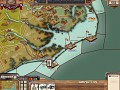
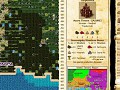
As of today, there are a lot of new resources on the map. These show up just like the Wood, Clay, Iron, Stone and Food that you can already gather with your caravans. Look for little icons on the map.
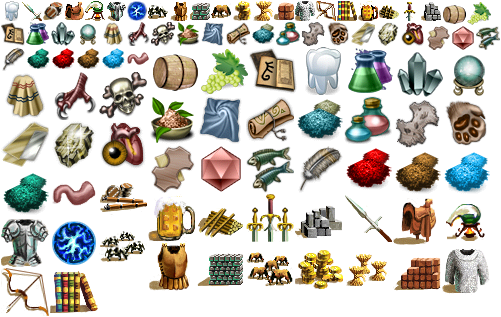
But these are different from the basic resources in several important ways:
- You cannot make them in your town. They can only be collected from the wilderness.
- The patches themselves are not randomly distributed in the way current resources are seeded on the map. There are several different sorts of resource patch, and they all follow very specific rules about where they appear, quantities of resources in each patch, and so on.
- You cannot gather these new resources with Caravans. They require specialist gathering units.
The patches are:
- Minerals
- Minerals with special resources
- Herbs
- Herbs with special resources
- Hides
- Hides with special resources
- Grapes
The basic patches, of Minerals, Herbs, Hides and Grapes, are gathered by basic labourer units called Cotters. Cotters live in Cottages which you can build in your settlements, and are recruited in your Market. One Cottage, one Cotter. Cottages cannot be built above level 1, so you are tying up a building plot just to build one Cottage, in order to have one Cotter. Players with big settlements will immediately notice that it is not worth tying up a building plot just for this. Small players with spare building plots will just as swiftly realise that they can easily build lots of cheap Cottages, in order to gather these resources.
Some patches also have special resources on them. We aren't saying how many types of resource there are, but let us say, more than 20.
Special resources are not gathered by Cotters, nor Caravans. These rare, special resources require highly skilled gatherers.
- If you want to gather from plant patches, you need Herbalists, for which you require a Herbalist's Guild building.
- If you want to gather from mineral deposits, you need Miners, from a Miner's Guild building.
- If you want to gather from animal drops, you need Skinners from a Skinner's Guild building.
Many players not be able to find room for three guild buildings in each of their towns. We know. You will have to pick and choose – to specialise your towns appropriately to the local availability of resources.
So, in more detail....
Grapes and Herbs are living things. They appear in appropriate terrain – some only in very specific areas, some more generally. If you exhaust all of a resource on one square, it will be destroyed, gone – you have dug up every plant, so it isn't growing back. Some patches are quite small, and will always be exhausted by a single Cotter, but others are quite large. If you harvest carefully from a larger patch, you can keep the patch going for a long time, as harvested contents do grow back. When a patch is eradicated it will likely respawn elsewhere on the map, to prevent the complete extinction of a genus.
Devious players will notice that unfriendly forces could deliberately over-harvest from a valuable square just to destroy it. We promise that that possibility had not even occurred to us. Honest.
Minerals are fixed, both the generic Minerals deposits, and those containing special resources. Mineral deposits can only yield a certain quantity of resources per day, but they can never be eradicated by over-gathering. Some of these deposits are very small. A very few deposits are extremely large, and these will require multiple Miners' Guilds to exploit. And by 'multiple' we do not mean 'two'.
Animal drops – Hides, and the special resources from animals - result from the skilful hunting, or mindless slaughter, of animals in the world by players' troops. These drops have fixed quantities, and do not regrow. Once the drop has been fully looted, or after a few days if not fully looted, the patch will disappear. In short, you the players therefore control when and where these appear, and the contents are dependent upon the animals killed. The hunchback will have something to say about this!
Gathering units working to collect Herbs, Minerals, Grapes, Hides or any specialist resources function in much the same way as Caravans.
- Only one set may be gathering on a square at any one time.
- Gatherers bump one another. If one set are gathering and a new group approach, the newcomers push the existing gatherers off the square, forcing them to return home.
- If Gatherers arrive on a square occupied by a military force with which they are not NAPed, they are killed. Equally, the arrival of hostile military forces on a square will cause the destruction of any undefended gathering units present.
However:
- The gathering units can work in parallel. For example, if you send 1 Miner to a deposit he will return after X hours. If you send 100, they return after exactly the same amount of time as one would have done – but obviously with 100 times the booty (if the deposit were that big!) This will allow you to gather a lot of resources from the really large patches and deposits, but only if your town has enough gathering units available.
- You cannot send mixed groups (e.g. Skinners and Herbalists, Cotters and Miners, etc.) to the same square at the same time.
- Different special resources have different gathering times. You will learn what these are by exploring the world – we are not publishing a list. In some cases, your gatherer might labour for nearly a whole day just to get one unit of a rare resource: if bumped off one second before completion, he gets nothing. Caravans always get something if interrupted – but Miners, Skinners and Herbalists do not.
The chocolate coating makes it go down easier!
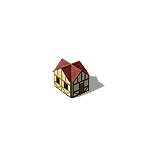
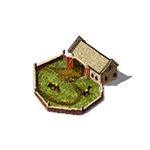
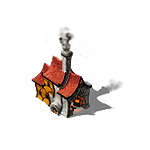
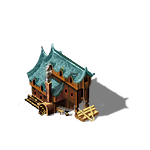
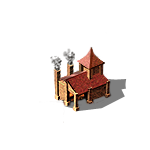
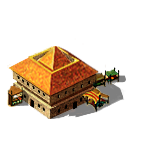
Nothing is made from just one ingredient. Most of the equipment that you might craft requires a single key special resource, and then some more common stuff.
Responsibility for creating military equipment comes from a range of new buildings.
Three Armourer buildings exist to allow you to craft special armours. The Leather Armourer works in conjunction with your Tanner (you will need both), the Chain Armourer with your Blacksmith, and the Plate Armourer with your Forge.
For weapons, a Swordsmith, Spearsmith and Bowyer work with, respectively, your Blacksmith to make swords, your Spearmaker to make spears, and your Fletcher to make bows.
And there's a Horse Trainer, who works with your Paddock to produce superior horses.
The exact requirements will become clear as you unlock each Research.
But as an example, a typical sword would require:
- 1 sword to start with
- 1 unit of Minerals
- 1 unit of a special resource (Silversteel, Iceheart, Arterium or Obsidian, for example)
- 10 gold
I ask only for the strength to defend my people!
Equipping military gear does not require a specialist building, but it does require you to complete the Military Outfitter Research. Once you have that Research, and once you have appropriate equipment, you can equip each Division in the Armies screen, and your Commander in the Commanders screen.
Troops may be equipped with superior versions of whatever they were built with. So, if you built a swordsman by using a sword and chainmail, then that swordsman can be upgraded with swords and chainmail. You cannot give bows to spearmen, leather armour to troops who only wear chainmail, etc. In the odd case where a soldier was recruited without a weapon (e.g. T1 Cavalry units), he will take a spear; if he was recruited without armour, he takes leather armour.
Commanders apply weapon bonuses to their skills after Commander skills are applied. So, giving a weapon with an Attack bonus to a Commander with a high Heroism skill is much more effective than giving it to a regular soldier. Three drops of your blood must be put in the potion.
This change does not take effect yet, but... in the next release we will be changing the spell casting rules.
In future, spells will require special resources to cast.
All spells will require some new resource to cast. The low level spells only need generic Minerals, Herbs or Hides. Big spells, like Nature's Bounty, will require something quite rare. So, although these resources cannot be used yet, the special resource that you will need are already live on the map. So, you can start collecting these ahead of the change to spell casting.
(Hint: the magic resources occur in very small quantities; if a deposit only has 2 or 3 pieces of a herb or mineral in it, at maximum, then it's probably a resource that is required for higher level spells.)
Well what did you expect? Pumpkin juice?
It's worth noting some of the consequences on this update:
- Towns weren't able to do everything before, and this is even more true now. Illyriad is a strategy game, and choices have consequences. You now have more flexibility in how you strategise your town builds.
- Troops are no longer simply divided into 4 types, 2 tiers, 4 races. You can now hone your troops for specific situations. Plenty of troop load-outs will give a +24% bonus to your troops, for example; with careful thought, you may find a way to get a considerably larger bonus than that; but the secret to all of this is to use the right equipment in the right situation. So, more strategy in the combat system.
- You will need to make sure that you only build buildings that are appropriate to the resources available to you. There is no point building a Herbalist's Guild if you have no access to special herb resources.
- People in different parts of the map will have access to different scarce resources. Think twice before building a building that requires a resource you don't have access to.
- All resources are gathered differently and the resource squares have a range of sizes. So, it is not just about finding a single optimal strategy for gathering everything – there will be a different optimal strategy for each resource, and indeed for each patch of that resource.
- Faction Hubs are going to be more important, because....
I would sell Haga to a slayer such as you?
You need to be able to trade this stuff, so we have upgraded the trade options with the release of Trade v2.
The Trade screens will be updated. This allows you to:
- Send any items (resources or equipment) direct to another player.
- Place orders from your town exactly as you did before, but only for the previous basic and advanced resources. You cannot place town orders for the new gatherable resources, nor for equipment.
- Accept orders in any visible Faction Hub
- Send goods, including the new resources and equipment, to the market at a Faction Hub.
So, to explain Faction Hubs:Each Faction Hub has a market, at which Orders may be placed. These can be Buy orders, or Sell orders. The difference is that goods for trade are present in the Faction Hub, not in your town AND these can include the new resources and equipment.Each player can see Orders available at the closest Faction Hub with which he or she has a Standing of -35 or better. (In most cases, that is just the closest Hub to you. Unless, for example, you decided to settle next to the Daedalons – they want to eat you, not trade with you.)If you can see a Faction Hub, you can Accept the orders placed there.
Simple enough. But...
- If you want to see what is available in other Faction Hubs, beyond that closest to you, you will have to send a Trader unit there.
- If you wish to place your own Buy or Sell orders in any Faction Hub, you must also start by sending a Trader unit to that Hub.
- Trader units are expensive to recruit, in terms of both gold and (from your second unit onwards) Wine. The cost of recruiting Traders is figured per player, not per town. The more you have, as a player not per settlement, the higher the recruitment costs.
- The number of Traders you can have is dependent upon the level of your Merchant Adventurer's Guild buildings.
- The number of Orders you can have live in Faction Hubs is dependent upon the Researches that you have completed and the level of your Trade Office buildings.
- In order to place a Sell order in a Faction Hub, you must first send the goods to that Hub. You do not need to leave your caravans there. You can just drop off the goods and bring the caravans home.
- When you accept Sell orders in a Faction Hub, you send your caravans to pick up the goods. Nobody brings the goods to you.
- You can send Caravans point-to-point between their your towns as well as the Faction Hubs. So you could just have Caravans shuttling between Hubs, rarely returning home.
As an aside on wine.... You will notice a new Wine Making Research. Wine is made from Grapes, so that explains why there are now Grapes resources on the map. (Fun fact: in the real world a barrel of wine requires 3960 bunches of grapes. So, guess how many Grapes resources are required for a barrel of wine in Illyriad? We expect prices for barrels of Wine to be... well, rather higher than for barrels of Beer.)
In summary, viewing distant Faction Hubs requires Trader units, which require a Merchant Adventurer's Guild. Placing orders also requires a Trade Office and relevant Researches.
Advanced warning regarding town-to-town trade: For now you can see all town orders, anywhere in Elgea. In the near future we will activate 'market visibility', which means that you will only be able to see town orders, and engage in town-to-town trade, within a fixed radius of your settlements. At that point having Trader units to trade in the Hubs will become increasingly important.
The Gold price, or the Iron price?
We have disabled the Theft of these new resources and equipment from towns, and also the looting of these items from towns by military forces.
In the future, we will turn Theft, looting and blockade back on.
This is a short term measure to let people gather a few items before needing to worry about protecting them from thieves and attacks.
Temporarily and to help any immediate debug issues, using blockade will not capture caravans or gatherers returning to a town.
Also at present, Trader units cannot be assassinated. We make no promises about whether or not this will change.
What will not change is this: any goods in a Faction Hub are safe. Resources, equipment and gold in a Faction Hub cannot be taken by thieves, nor by armies.
And Finally...
This release has many inter-dependencies both between the new systems as well as with existing systems. We have therefore chosen to stagger the release into some separate component parts. Going live right now is:
- New resources on the world map
- New gathering technologies, buildings and units
- The ability to use these units to gather the new resources and bring them back to your town
- Trade v2
These components:
- The new UI for Trade v2.
- This means that you won't immediately be able to send the new goods out to trade hubs for sale. However there are a few researches to be completed and buildings to be built to enable the trader unit (and therefore actually do faction hub trade), we don't see this as an issue that will affect anyone; it's more a "heads-up" that the Trade Market UI will be changing.
- The taxation of goods sales on the town marketplace to other players.
- Town trade visibility (more on this topic when we put the new trade UI live)
- Crafting. We are not immediately releasing the new crafting technologies and buildings.
... are being staggered during this release.
So they're not going to be on the live server the moment you get back ingame, and will be switched on independently (so don't panic if you can't see the new crafting technologies, they're just not there right now!)
Hope you enjoy





Looks good.
Just care, these images Scream for graphic theft. There are many cheap asia mmos stealing sprites like these, even from big companies. And this is really like finding the gold pot behind the rainbow.
Thanks for the heads-up :-)